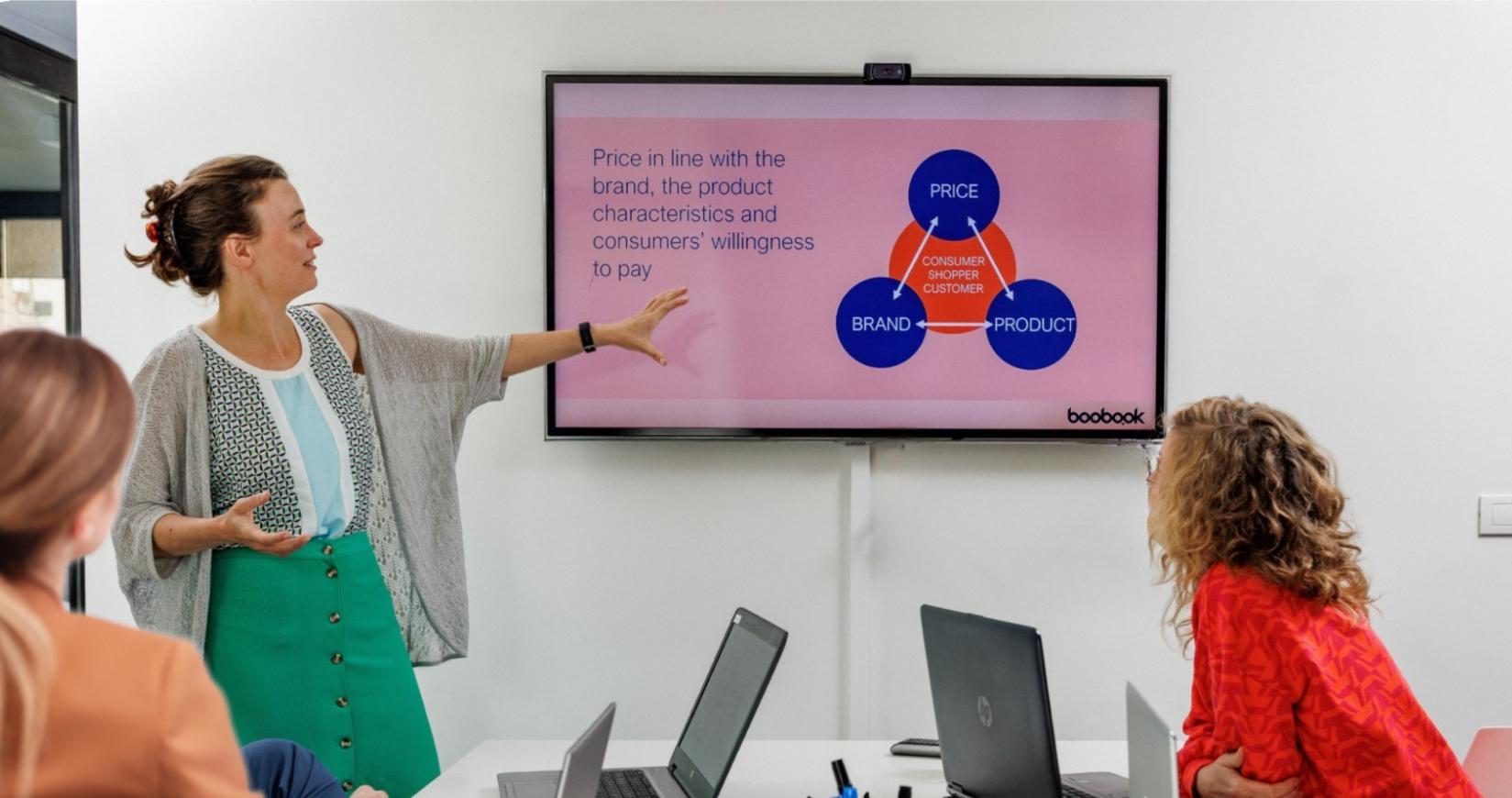
Following our strategic pricing webinar, we reconnected with pricing expert Lyla Copeland. She shared that she still draws on boobook’s pricing coaching, which she followed a few years ago before joining Stibo Systems, where she is now Director of Pricing and Monetisation.
While the coaching was tailored to the specific context of a former employer, the framework has clearly stood the test of time, remaining relevant even as her professional role and context evolved.
Get the pricing team aligned
The training was organised with a clear goal in mind. Lyla looks back at the challenge her team faced at the time. “A new pricing team was being formed. With everyone coming from different backgrounds, bringing their own experiences and ways of working, the company wanted to make sure everyone had the same pricing skills and a shared approach to lead pricing projects.”
The impact went beyond individual skill development and raised the bar for the team as a whole. “The biggest asset of the training for me was the 10-step approach to price- setting. Everyone had their own strengths and skills, and after the training we had a clear view of where each person’s expertise fit”, says Lyla.
With that shared structure in place, the team was able to approach pricing projects with a shared logic, while deliberately building on the strengths of each team member.
Define the scope before diving into data
One of the key learnings of the training was the importance of slowing down before jumping into data collection and analyses. While it is tempting to dive headfirst into available data, the team learned to first step back and critically question what they actually wanted to know and what business goal the research should serve.
Is the objective to understand how pricing can support brand positioning? Or to determine the right price for a new product? Or maybe to drive volume or rather sharpen differentiation versus competitors? These strategic choices ultimately determine which research approach is needed and which questions should be asked.
That shift in thinking did not happen overnight. Challenging assumptions, sharpening the scope of pricing projects and refining questions became an iterative process that unfolded over several weeks.

Leading with a hypothesis
Learning how to formulate and work with a hypothesis made all the difference for Lyla’s team. “After the training, we started leading our conversations with a hypothesis and felt comfortable sharing our thinking based on the information we had at that point”, she explains. “We knew it still had to be tested, but that didn’t stop us from putting assumptions on the table.”
That shift changed the dynamic within the team. Where people previously held back until all facts were available, hypotheses became a shared working tool. It led to richer discussions, sharper thinking and, ultimately, stronger pricing outcomes.
“How many times did we build and rebuild our hypothesis?” Lyla recalls. “Everyone brought a different perspective, and teasing out all those nuances to arrive at a shared foundation proved incredibly valuable.”
The team also learned to weigh up all relevant input coming their way. “Insights from sales, marketing, existing data and internal expertise all matter. When you take them into account while building your recommendations, you feel confident that you’re using the information available in an effective way. Following a fixed set of steps to build a recommendation is something I’m still doing today, at Stibo.”
A tailored approach that’s broadly applicable
Lyla appreciated that the training was never purely theoretical. Real business challenges and ongoing projects formed the backbone of the sessions, ensuring that the framework translated directly into practice. At the same time, it proved relevant well beyond its original context.
“Whether you’re working on a quantitative or qualitative project, you can pick and use the steps that are relevant to your specific context. Before moving into B2B I’ve worked in FMCG for a long time and we would have massively benefited from this kind of coaching. It would have given us far more control when working with consultants.”
What stood out to us was that the framework continued to add value beyond its original setting. Seeing Lyla still apply it today, in a different role and organisation, underlines the importance of building pricing capability that lasts.
Curious how on-the-job pricing training can strengthen strategic pricing capability within your team? Get in touch to schedule a call.
.png)


