Help your business grow with **value-driven segmentation**
A good segmentation does more than describe customers. It helps an organisation decide where to play, whom to prioritise and how to win. At boobook, we build value-driven segmentations that connect customer needs with commercial potential and are designed for action from day one.

Table of contents
- The power of customer segmentation
- The right segmentation for the right decision
- Why we believe in value-driven needs segmentation
- Segmentation designed for action
- How we approach segmentation
- Bringing segmentation to life
- Keeping it relevant over time
- Discover our case studies
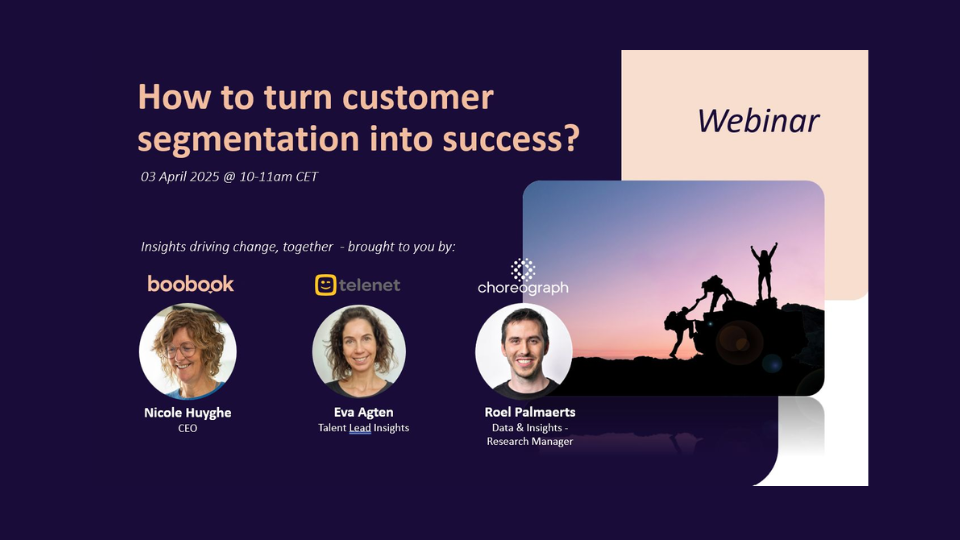
- Watch our webinar: learnings from Telenet

The power of **customer segmentation**
While personalisation helps you tailor individual interactions, customer segmentation provides the strategic framework behind it. It tells you which customers and needs matter most, where growth will come from and which choices deserve investment.
Segmentation enables you to:
- Prioritise the customers and opportunities with the greatest value potential
- Shape propositions, portfolios and experiences around meaningful needs
- Guide brand, innovation, pricing, communication and go-to-market decisions
- Focus commercial activation and improve return on investment

The **right segmentation** for the right decision
Some organisations need a shared strategic lens for brand, portfolio and innovation choices. Others need an operational model that supports CRM, targeting and sales.
We start with the business decisions the segmentation must improve, then design the most relevant combination of needs, motivations, behaviour and customer value. The model follows the business question, not the other way around.

Segmentation designed for **action**
When segmentation studies fail, it's often not because of poor methodology, but because they never become part of how the organisation makes decisions. That's why activation is embedded in our approach from day one.
From the start, we:
- Listen to customers and internal stakeholders with equal care
- Prioritise the use cases and segments with the biggest potential impact
- Aim for improvement rather than a perfect, all-encompassing solution
- Translate insights into clear choices and actions for each team
- Create ownership, governance and discipline to keep the segmentation alive

Why we believe in **value-driven needs segmentation**
Mapping needs helps explain customers' choices, while commercial value shows you where to focus. By combining needs with indicators such as profitability, growth potential and willingness to pay, we identify the segments that matter most and clarify how best to approach them.
The result is more than an interesting customer typology. It provides a strategic basis for prioritisation, proposition design and profitable growth.

How we **approach** segmentation
Step 1: define the decisions
We align stakeholders around your business goals, priorities and the decisions the segmentation needs to support.
Step 2: build the evidence
We combine existing data with qualitative and quantitative research to uncover customer needs, determine the size of each segment and assess its value potential.
Step 3: prioritise and activate
We translate the model into clear choices, propositions and action plans for marketing, innovation, sales, CRM, pricing and customer experience.
Step 4: embed and evolve
We equip your teams with practical tools, establish clear ownership and keep the segmentation relevant as customer needs and business priorities evolve.

Bringing segmentation **to life**
To bring segments into everyday decision-making, we equip your teams with practical tools tailored to your organisation’s needs, such as golden questions, CRM tagging, team-specificaction plans, activation workshops, dashboards, ongoing research, persona cards and AI-supported persona bots such as Victor & Maria.
These bots allow your teams to interact with customer segments and get to know their needs, motivations and behaviours. By making segments feel more real, they help teams connect with them and put insights into practice.

Keep your segmentation **relevant over time**
Customer needs, markets and business priorities evolve. Segmentation should therefore be managed as a living asset, not a one-off research output. By regularly updating and refining your segmentation, you keep it relevant for different teams while maintaining a shared strategic direction.
“Thank you for the smooth collaboration and the flexibility throughout the project. Everyone is very enthusiastic about the outcome and pleased with the results.”
“Thank you for the smooth collaboration and the flexibility throughout the project. Everyone is very enthusiastic about the outcome and pleased with the results.”


“Boobook is always really clear on the business, its constraints, and how the business can use the data. In terms of putting activation ideas on the table, they're well thought out and relevant for our needs”.
“Boobook is always really clear on the business, its constraints, and how the business can use the data. In terms of putting activation ideas on the table, they're well thought out and relevant for our needs”.

Make better
business decisions
Explore our success stories and learn how we've successfully helped different businesses. Or get in touch with us to schedule an introductory call.


